The rooms, in order
The apartments route moves through four spaces, each from a different chapter of the building's history.
The loggia sits at the end of the route — there's no way to reach it without walking through the apartments and salons first.
- First
The intendant's apartments
Pierre-Élisabeth de Fontanieu, intendant of the Garde-Meuble from 1767, lived on site. His rooms, and those of his successor, have been restored and furnished to evoke the late 18th century, before the Revolution.
- Second
The Salon d'Honneur
A grand reception room on the façade's ceremonial run of salons, its tall windows looking straight out over the Place de la Concorde.
- Third
The Salon Diplomatique
Under the old regime this was the room where the crown's jewels were kept. After the Revolution it became a diplomatic reception room.
- Fourth
The loggia
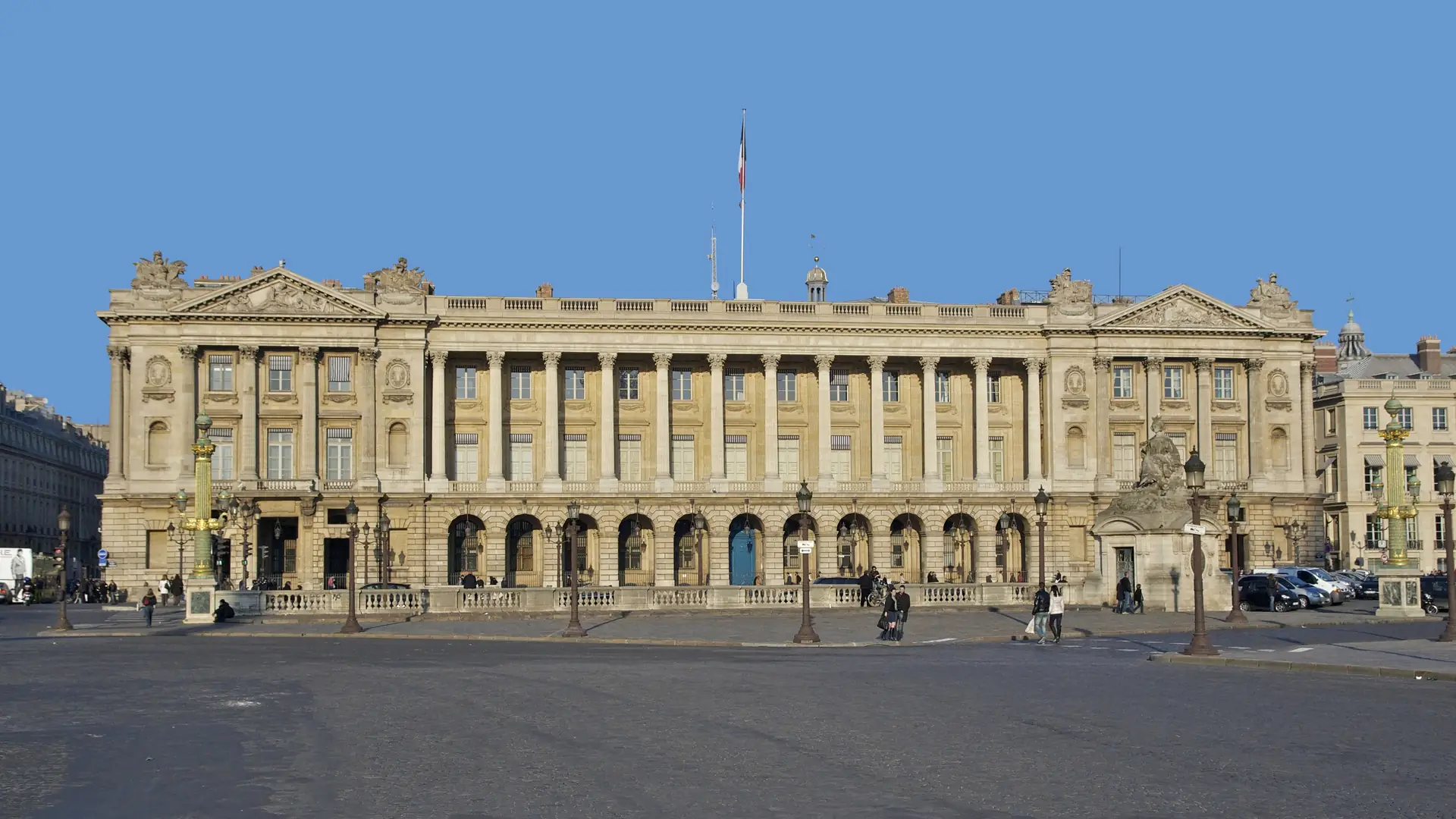
The colonnaded gallery running along the façade, with twelve Corinthian columns and a view straight across the Place de la Concorde and its obelisk.
From storehouse to navy to museum
A furniture store built for a king
The Hôtel de la Marine was raised between 1757 and 1774 to designs by Ange-Jacques Gabriel and housed the Garde-Meuble de la Couronne, the royal office that stored, maintained and displayed the crown's furniture, tapestries, arms and jewels. Its galleries opened to the public on set days, which makes the Garde-Meuble one of the first museums of decorative arts in Paris.
The room where the Crown Jewels disappeared
In September 1792, with the monarchy overthrown and Paris in upheaval, thieves broke into the Garde-Meuble over several nights and carried off most of the Crown Jewels, including the Regent Diamond, which had been set in the coronation crowns of Louis XV and Louis XVI. Most of the haul was eventually recovered, though not all of it. The Regent turned up the following year, hidden in the timbers of a Paris attic, and is held today at the Louvre.
More than two centuries as the navy's address
From 1789 the building housed the French Navy's ministry, a tenancy that ran until 2015 and is the reason the palace carries the name Hôtel de la Marine at all. The gilded decoration of the state salons along the façade dates from a major 19th-century refit made during the naval years, rather than from the original royal fit-out.
Four years of restoration, reopened in 2021
The Centre des monuments nationaux restored the building after the Navy left, opening it to visitors in June 2021 with the intendant's apartments returned to their 18th-century appearance and the state salons to their 19th-century splendour. The building also holds the Al Thani Collection, a rotating display of works from a private collection, shown on a separate ticket from the apartments route described in this guide.
Before you go
A short rundown of hours, getting there and who gets in free.
Hours
Open daily, with a late opening on Friday evenings, and closed on a few public holidays. Current times and last-entry rules are on the palace's own site.
Address and getting there
2 Place de la Concorde, on the square's northern side. Métro Concorde (lines 1, 8 and 12) and Métro Madeleine (line 14) are both a few minutes' walk.
Who gets in free
Visitors under 18 and EU residents aged 18 to 25 with ID, along with visitors with disabilities and the person accompanying them.
Getting around
The visit has wheelchair-accessible routes, but the intendant's apartments are arranged in rooms too narrow for a wheelchair wider than 65cm, so it's worth checking ahead if that affects your visit.
Priced and charged in your own currency on Viator — nothing added on our side.
Guides to the palace
Timing
The best time to visit the Hôtel de la Marine
Timed slots, the Friday late opening, and which hour gives you the loggia at its best.
Read this guide →Inside
What to see inside the Hôtel de la Marine
The intendant's apartments, the gilded state salons, and the loggia that ends the visit.
Read this guide →With children
The Hôtel de la Marine with kids
Why an 18th-century palace works better with children than you'd expect, and how to time it.
Read this guide →History
The Hôtel de la Marine and the Crown Jewels theft
How a royal storehouse became the scene of the great jewel theft of September 1792.
Read this guide →Comparing
Hôtel de la Marine or the Louvre
Two landmarks a few minutes apart on the same axis, and how to fit both into one day.
Read this guide →Questions about visiting
What is the Hôtel de la Marine?
An 18th-century palace on the Place de la Concorde in Paris, built between 1757 and 1774 and home to the Garde-Meuble de la Couronne, the royal office for the crown's furniture and jewels. It then served as the French Navy's ministry from 1789 until 2015, and reopened to visitors in 2021.
What does the ticket actually include?
The route described in this guide covers the intendant's apartments, the gilded state salons along the façade and the loggia over the Place de la Concorde, with a headset that plays spatialised 3D sound as you go. The Al Thani Collection is a separate exhibition with its own ticket.
Is this the building where the Crown Jewels were stolen?
Yes. In September 1792 thieves broke into the Garde-Meuble and made off with most of the Crown Jewels, including the Regent Diamond, which was recovered the following year and is held today at the Louvre. The Salon Diplomatique on the visit route was the room where the jewels were kept.
Is it suitable for children?
Generally yes. The visit is self-paced, and the 3D-sound headset tends to hold children's attention better than a traditional museum. Under-18s also enter free, as do EU residents aged 18 to 25 with ID.
How do I get to the Hôtel de la Marine?
It's at 2 Place de la Concorde, on the square's northern side. Métro Concorde (lines 1, 8 and 12) and Métro Madeleine (line 14) are both a short walk, and it sits a few minutes from the Tuileries Garden and the Louvre.
When is it open?
Every day, with a late opening on Fridays; it closes on a few public holidays. Times and last-entry rules can change, so check the palace's own site before you go.
Who runs the Hôtel de la Marine, and where do I book?
The palace is cared for by the Centre des monuments nationaux, a French public body, which sells entry and lists current exhibitions on its own site. This guide is independent of it; the entry links here go to a ticket for the apartments route on Viator.